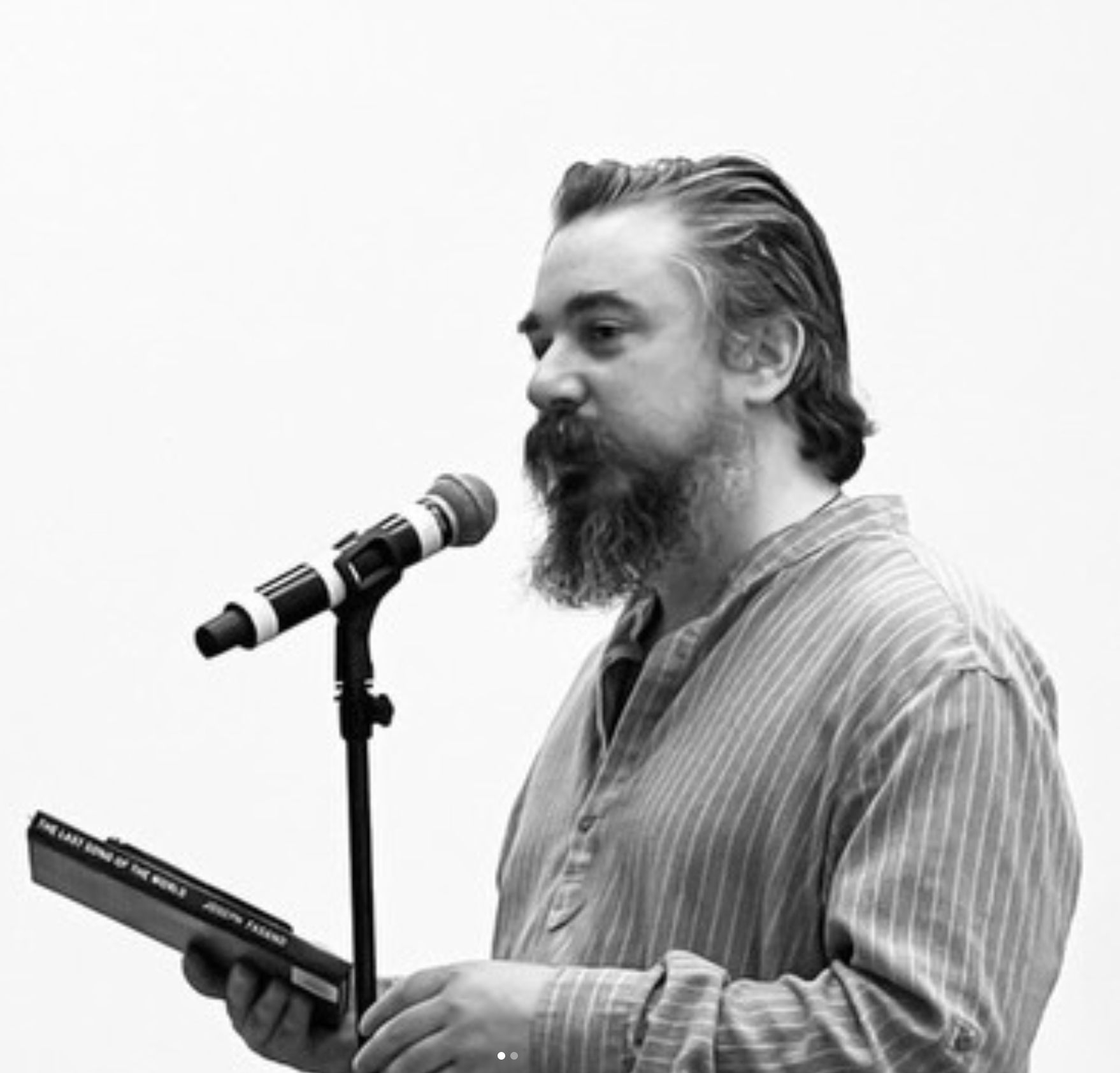
Joseph Fasano
Poet, teacher, founder of his own writing academy
I met Joseph Fasano on a video call I nearly missed because my ancient iMac's video card gave up and left me watching the rainbow wheel of doom go round. He is a poet who spent twenty years as a university professor, walked away from it, and now teaches everybody from teenagers to pensioners in an academy of his own.
Why we spoke
I had come across his work the day before. One post, a Louis Armstrong quote, and I thought, right, I need this man's mind on what is happening to us. I also wanted someone who makes the thing AI is best at faking. If a poet tells me the machines are close, I will believe him, and if he tells me they are not, I want to hear why.
What they brought to the book
He gave me the cleanest account I have of what a human writer does that a machine does not, and he gave it in kitchen smells rather than theory. He named courage without knowing he was naming it, which slotted straight into the four soul skills. And he stopped me mid-argument to point out that I had welded quality of life to income as though the two were the same object. I had. I have been unpicking that since he said it.
The key insight
The machines make logical connections that look emotional because they have eaten so much of our writing. What a poem does is leap. And even if a machine one day leaps too, it still cannot live your life for you, which was the only question worth asking all along.
What it can't do is live for you.
Joseph Fasano
Joseph Fasano is a poet and a teacher, born in 1982, which makes him a zennial, same as me, the last lot to grow up entirely without the internet and then hand our whole adulthood over to it. He was a university professor for twenty years. Then he quit, because a university only ever gives you one generation at a time, and he wanted the whole room. He runs his own academy now, teaching young students and old ones together. He has a large following on Instagram, X and a respectable one on Threads, and a four-year-old son he thinks may belong to the generation that pushes all of this back the other way.
He put on a pair of blue-tinted glasses within the first minute and apologised for it, in case it was rude. His eyes strain at the screen. Mine were sore too, from lenses somebody sold me as computer lenses, which have done precisely nothing except make me look studious while I squint. So we started there, two middle-aged people comparing eye damage across eleven time zones, and I want that on the record, because everything he went on to say about machines was said by a man whose body is quietly wearing out from looking at one.
I told him what I always tell people at that point in a call. I did not mean to write a book. I make notes on my phone when I cannot sleep, and one night in September the note was oh God, AI is going to take my job, and by morning it had become a list, and then a journal, and then this. And I told him the thing underneath it, which is the fear that the window is closing. That the sea of machine-made drivel is rising fast enough to drown anything human that goes into the water after it, Dickens included.
I work with a lot of young people and they are craving the human right now.
He did not agree, and he did not soothe me either. He said the slop is coming, no question, but that he works with young people every day and they are starving for the human, and that real work will get through and may even shine harder against the noise. Then he made the argument I did not expect from a poet, which was economic. On Corey Doctorow’s reading the whole thing is losing money, all over the place, so no, he does not accept that AI is simply going to happen and we had all better get on board. He said he disagrees with that, flatly, the way you would decline a second helping.
His real objection was to the shape of the prediction rather than its content. People look at a river, he said, and assume it will keep running the way it is running today. History behaves more like a pendulum. One generation buried in its phones, the next one in revolt. He sees the revolt already. I wondered aloud about the children who looked up from the sandpit for the last fifteen years and found their mother’s face lit blue by a screen, and what that abandonment does, and he took it as evidence for his own case rather than against it. His son is four. He suspects that boy’s whole cohort will be the swing.
Then I put the hard version to him, because somebody has to. There are more of us every year, all of us needing money to live, and if the machines take the jobs the money concentrates upstairs and everyone else gets the Industrial Revolution again, in worse weather. He agreed. Not just the white-collar work either. Robots on the refineries, robots making the microchips, the whole assembly line gone, and then what happens to the people the economists so charmingly call unskilled. He said that is a problem and he does not know the answer, and I liked him more for the flatness of it. Nobody knows. He said that too.
True human poems, true human works of fiction, in a way, they'll actually start to shine even more.
What he offered instead was two things. A challenge, first, aimed at me. I had put quality of life and financial well-being into the same sentence as though they were one item, and he asked me to hold that up to the light. He knows people in monasteries living the deepest lives he can imagine. Consumerism taught us the equation and we have never once audited it. He was careful to say it was not a criticism. It landed as one anyway, in the useful way.
Second, a vision he called foolish himself. Education in the West has spent decades preparing people to earn, and AI may be about to prove that this was a dead end all along. If the money paths close, perhaps education comes back to making whole human beings, arts and humanities and philosophy and ethics, and perhaps the new work turns out to be the work that needs exactly that. Ethical consultants. Artists. Teachers of critical thinking, sold direct, no Ivy League required, which is the point of his academy. For those left out entirely he imagines micro markets, the twenty-year-old obsessed with sneaker design who skips the degree and the internship and builds a small paying community around the obsession instead. Less institution, more precarity, and it needs one thing above all.
He has done it himself. He committed young to work he knew would make no money and, in his words, risked poverty and nothingness and oblivion and hell. He mentioned battles he did not want to go into and I did not push. When he finished, I told him that in the contents I had sent him the four soul skills are trust, judgement, taste and courage, and that he had just spent five minutes describing courage. He said, beautiful. Then he said he had two minutes left.
It's a fool's errand to try to predict the future in the world that we live in today.
So I asked the writing question fast. What can a human writer sense that a machine misses? Smell, it turns out. You walk into your grandmother’s kitchen and there are marigolds on the sill or bread in the oven, and something fires in you and runs straight to a memory. The machines do not do that. They make logical connections, or stochastic ones, that pass for emotional because they have swallowed so much of our writing. What poems do is leap, which is Robert Bly’s word, and the leap is what makes a reader feel understood, the chaos of a life suddenly given form.
He thinks the machines will get asymptotically close and never quite arrive. Then he refused to rest the argument there, which is the part I did not see coming. Even if they arrived, he said, how would that change how a person should live in order to feel fulfilled. Make art, love each other, read books, feel. We are too product-oriented to hear the question properly. We keep asking what AI can make that we cannot, when the thing it cannot do is live for us.
I sat in my study in Cape Town afterwards with the rainbow wheel finally still, and rang nobody, and made no notes for a while.
Two minutes on the clock and I asked him to write the foreword, which was cheeky of me, having known the man for half an hour. Send it through Emma, he said. And then: of course, you always have to ask.
Elsewhere in the archive
Sources
- Robert Bly, on the "leap" in poetry
- Corey Doctorow, recent writing on the AI bubble
In their words: Joseph Fasano
47 moments from the interview. Scroll to read on.