10 August 2026
He Didn’t Know He Had Ideas
A man wrote a novel with a machine, found out he had ideas, and got told off by half the internet for admitting it.
Everyone’s fighting about whether AI killed writing. Nobody’s noticed you still had to do the writing.
There’s a man I’ve never met who told the internet he wrote a novel with a machine and found out, somewhere in the doing of it, that he had ideas. He seemed astonished. Stunned, really, the way you’d be stunned to open a cupboard you’d walked past for years and find it stuffed with cash you never knew was in there. He didn’t know it was in there. And he said so, plainly, to a few thousand strangers, most of whom rolled up their sleeves to explain that he ought to be ashamed of himself.
Because that same week, on that same endless scrolling feed, the writers were out in force. The real ones(or at least the ones who’ll tell you they’re the real ones.) They post their positions like commandments chipped into stone. I will never use AI. It is theft, it is cheating, it is the slow poisoning of something holy. And there on the wrong side of the line they’d drawn stood our man with his novel and his cupboard full of money, looking pleased with himself only to be told off for it.
I keep thinking of his phrasing. The claim he actually made was smaller and stranger than the one they shouted him down for: the machine helped him find out the ideas were his. Which is an odd thing to say, and a very human one, and it happens to be the exact thing the whole shouting match is walking straight past.
We like to call it laziness, because laziness is comforting, it makes the problem a moral failing that belongs to other people (and sometimes, fine, it is.) But mostly it’s the sheer grinding volume of everything. You wake up and the inbox has bred overnight, and there’s a to-do list that didn’t exist yesterday precisely because the machine made yesterday’s list vanish so efficiently that someone upstairs decided you now had room for three more projects. The great promise was that the machine would hand you time. What it handed your boss was the confidence to ask for more so you’re busier than you’ve ever been, only in a new and unfamiliar shape.
Writing used to live folded into the day. You’d sit with a paragraph or a difficult email and be forced to think the thing through, because your thinking happened in the writing itself, in the act of starting a sentence and discovering somewhere near the end of it what you actually believed. That was the labour, and it was also the entire point, because that’s where the ideas came from in the first place. Nobody has time for it now. There’s no room left for the slow crawl of a thought working itself out on the page, not with seventeen other things stacked up behind it, blinking. So you hand it to the machine, which is quick, and quick is the only currency the day trades in, and in that swap something goes missing that isn’t the ability to string words together but the room to think while you do it, which turns out to have been the same thing all along.
And yet. There’s a thing happening here that won’t sit neatly inside the complaint, which is that some people are discovering they can think because of the machine, and not in spite of it. For them the blank page was never a canvas, it was a wall, a smooth white wall that told them writing was a thing done by other people, people with permission, people who’d done the degree or published the book or been anointed somehow. And the machine, entirely by accident, hands them the permission. It writes appallingly and it makes the wall disappear, and only the second thing matters to someone who could never get started.
You can say a rough, stupid, half-formed thing to a robot in a way you’d never dare say it to a piece of paper, because the paper judges and the robot merely receives, blank-faced, and hands you back a shape. Somebody else’s shape, badly fitted. And you read it and something in you goes no, that’s not it, that’s not what I meant at all, and you start shoving the words around, and while shoving you find out what you did mean. You’ve written something. Badly, yes. But written. So the machine isn’t taking these people’s place so much as dragging them into becoming writers whether they agreed to it or not, and a few of them will carry on, and a few will work out that they’ve got something to say and would rather say it well than fast, and they’ll sit down one day, properly sit down, and do it without the machine at all. Which is a start. Even if the person doing it still believes, innocently, that the machine did the heavy lifting.
Our man with the novel would tell you, I’m certain, that the machine saved him time. Everyone says it. It saved me hours, it saved my whole afternoon, it did in ten minutes what used to eat a morning. And this is the sleight of hand, performed so smoothly that we go and perform it on ourselves, because nobody counts the prompting. Nobody counts the re-prompting, reading it back, the no-that’s-not-quite-my-voice-try-again, and the slow grey dawning that you never knew what you wanted until the machine showed you, in cold text, exactly what you didn’t. Which is all time, all labour, all of it you, thinking, in the least efficient shape the activity comes in.
An hour spent writing it yourself, messy and bad-tempered, one long unbroken sit where you fight your own sentences and bin whole paragraphs and finally land the one that passes. Set that against two hours of briefing a machine, reading its attempts, explaining its failures back to it, waiting, correcting, nearly-there, now-make-it-more-like-me. The second way feels faster because the effort is scattered into a dozen little pieces instead of gathered into one heavy concentrated unpleasant lump. But the effort was still there. It just put on a disguise and started calling itself convenience.
Once upon a time, good handwriting really mattered. It was taught like a survival skill, with competitions and certificates and somebody’s mother forever leaning over a shoulder to correct the slant of a lowercase g. Everyone can still do it but almost nobody does, beyond a birthday card or a signature or a list for the shops, and the few who sit down with a proper pen to write letters or fill journals get treated as faintly eccentric, and what they make gets called precious, because precious is what we call things once they’ve stopped being dull. Conversation went the same way while we weren’t watching. Everyone talks. Fewer people listen, or hold a thought steady in real time, or manage to admit they don’t know a thing rather than filling the silence with noise, and we don’t mourn conversation as a lost art because it’s free and easy and you can be terrible at it in public without much consequence.
Writing looks to be next in the queue. Everyone will be able to make words. The expectation that the words be any good is the thing that packs its bags and leaves. The people who genuinely sit with it will thin out, the ones who find out halfway down the page what they think, then delete a paragraph because it isn’t quite true enough to keep, who can feel the difference between a sentence that sounds good and a sentence that sounds like them. They won’t vanish. They’ll just get rarer, like people who still write letters, like calligraphers, still around, still lovely to come across, no longer the thing everybody simply does. And perhaps that’s fine, perhaps not everything has to be for everybody.
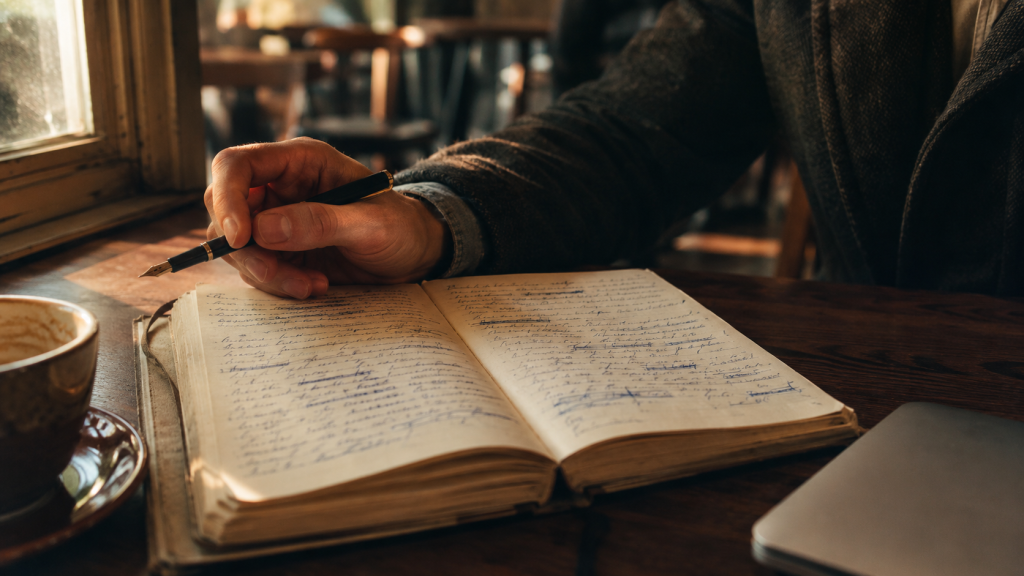
There was a woman in a café on Sunday, one of those places on Kloof Street where the coffee costs more than the sandwich and every laptop in the room is open. She had a notebook and an actual pen and she was crossing things out physically with ink, wearing the miserable face of somebody losing an argument with herself on paper. It looked like an expensive kind of effort and I very nearly leaned over to tell her about the shortcut, the machine, the prompt, the thirty seconds instead of the thirty minutes, all the ways she could be done and free and on to the next thing. But I didn’t, in the end. I jut sat and watched her do it the slow laborious wrong-looking way instead, scratching out one sentence and writing the next and scratching that out too, and the longer I watched the less I wanted to rescue her from it. She was so entirely there, present, fighting her own head over the right word rather than handing the fight to something that would hand it back to her sounding like a stranger doing an impression of her.
Some things don’t scale. Some aren’t built to. And the sort of writing she was doing, which isn’t the making of words so much as the using of a page to find out what you actually think, is one of them. It doesn’t get faster, it can’t be optimised, and it takes exactly as long as it takes, which is, inconveniently, its value.
Which leaves me somewhere I don’t much like, holding a question that follows me round the house and won’t be put aside. If I read something now, a paragraph or a post or even a whole book, and I simply cannot tell whether a person bled over it or a machine coughed it up in the time it takes to boil a kettle, does that change what I believe about it? Does the labour count for anything once it’s turned invisible? And if it does count, if some stubborn part of us still wants the words to have cost the writer something, then what exactly are we handing over each time we let the machine pay the price on our behalf?
I have no idea. I’ve been turning it over and over and I’m no closer. But I suspect that’s the next thing worth writing about, once I’ve worked out how to write it. By hand, probably. Slowly, crossing most of it out.
Subscribe to get every new Human Still Wins essay straight to your inbox.