20 October 2026
It’s Hard to Believe You Meant It When There Isn’t a Single Typo
The Weekly Evidence, No. 8
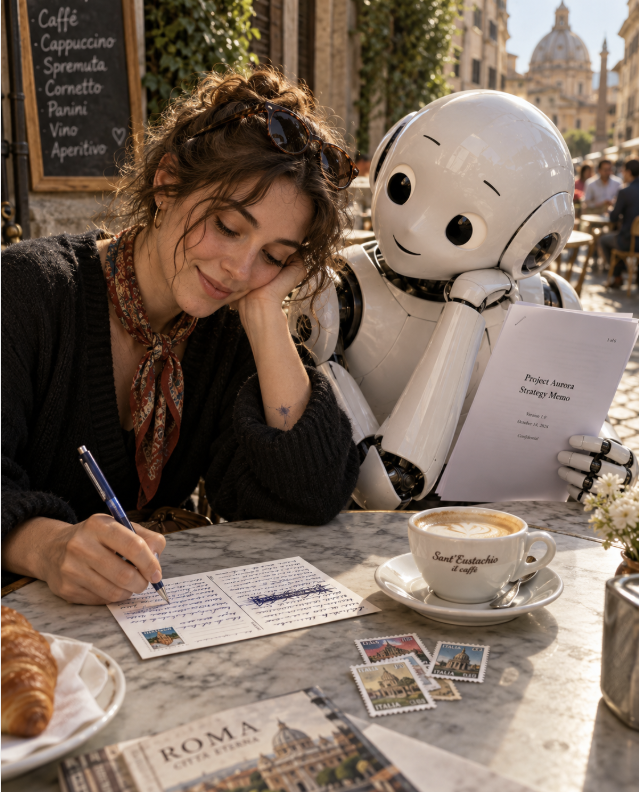
The postcard came wedged between a pizza menu and a final demand from the municipality, and it had a moose on the front wearing sunglasses. My cousin in Vancouver had written on the back in a hand that slid downhill towards the stamp, which was stuck on upside down, and the whole message ran to about thirty words, two of them misspelt and one crossed out so hard the pen had gone through the card. Coffee here is rubbish. Thinking of you. Come in spring when the cherry blossoms do their thing. I stood in the passage in my socks and read it four times.
That same morning a birthday message arrived by email from someone I worked with years ago: four tidy paragraphs wishing me a year of growth and meaningful connection, a line about my “unique journey”, and not one wrong letter anywhere. It was perfectly kind. I felt absolutely nothing, then felt guilty about feeling nothing, then archived it and went back to the moose.
Steve Huynh spent almost twenty years at Amazon, and on 14 October he published a long piece about what’s happened to its famous memos. Back in 2004 Jeff Bezos banned PowerPoint from meetings with his senior team, and what replaced the slides was the six-page memo. In an hour-long meeting the first thirty minutes were “study hall”, everyone round the table reading in silence like it was an exam. Bezos told Fortune in 2012, “There is no way to write a six-page, narratively structured memo and not have clear thinking.” Huynh puts it more simply: “A document used to be proof of thought. If you handed me six pages, I knew that you had spent significant time with the problem.”
A model will now produce the six pages before the Nespresso machine has finished its cycle, and from what Huynh hears, the moment one could turn out a six-pager that passed for human, “they stopped being written by humans.” A senior engineer in his circle has started tagging documents “AI;DR” (AI; didn’t read). In the engineer’s view, “If a model wrote it, a model can summarize it.”
I should say Huynh left Amazon in 2024 to make content full time, he still owns shares, and he writes that everything since then is “secondhand and filtered through former colleagues”. So this is one well-placed former insider’s account, with no word from Amazon itself.
When I wrote Matric (which is what South Africans call the final school exams and then talk about for the rest of their lives), we sat in rows in a hall that smelt of floor polish and nerves, writing English essays by hand in blue ink while an invigilator in navy shoes paced between the desks. My essay was about a lighthouse, I think, and it was dreadful. Nobody marking it could have doubted I wrote every dreadful word myself, because a woman in sensible shoes had watched me do it.
Anthropic, which makes AI models and would very much like you to use more of them, published a note on 16 October about what’s happened inside its own offices. By August there were six times more agents than employees, and productivity went up. The note admits an AI lab is hardly a typical workplace, and it calls its own measure of code per person “notoriously imperfect”. Then it says, “All this acceleration means that, increasingly, the bottleneck is human attention.”
Huynh’s fix borrows from Bezos, who sorted decisions into one-way doors you can’t walk back through and two-way doors you can. “Two-way doors can be AI,” Huynh writes. “One-way doors require humans.” His other rule is shorter: “You own every word.” I suspect that one is harder than it sounds, because owning every word of six pages you didn’t write means reading them as if you had, slowly, with a pen, and I’ve yet to see a calendar with a slot for that.
Karen Carpenter spent a whole song pleading with the postman to look in his bag one more time, and I’ve never heard anyone plead for four paragraphs about their unique journey. I’ve been humming the Carpenters’ “Please Mr. Postman” at everyone in my building since Tuesday.
I wrote back to Vancouver last night on a card with a hippo on it. It took three goes; I spelt ‘rhythm’ wrong on the second and dragged my sleeve through the third. I’ve bought eleven stamps for one card, and I’m choosing not to examine that.