The Invisible Line
When execution is cheap, the premium is the named human who owns the outcome.
The first thing the factory wanted from me was proof I was sober.
It was a food manufacturing site, out past the industrial edge of the city, one of those places that makes the things you eat without ever wanting you to picture it being made. You sign in at a desk, and before you go a step further there’s a breathalyser bolted to the wall by the door, the same dull grey as everything else, and a guard who has watched a thousand people do this and has no intention of watching me make it a moment. You blow into the tube. A light goes green. Only then does the floor open to you.
While I waited, reception printed my name badge. The machine, or the person feeding it, had got the ‘x’ wrong in my surname ‘Fox’ and so the laminated card slid across the desk to me read just about the rudest word there is in Afrikaans. The receptionist didn’t even crack a grin. I said I’d carry it rather than wear it. She said that was fine, without looking up.
Out on the floor, later, a man nodded back towards the breathalyser at the door. “We won’t need one of those for the computers when AI takes over,” he said. “At least it doesn’t turn up drunk.”
He’s right. It doesn’t. It doesn’t turn up three coffees deep and seething about something that happened at home. But I’m fairly sure that breathalyser was never really about the drink. I think it was about having a body at the door that could be held to account for whatever happened past it. A grey tube you breathe into at a food factory on a Friday morning is a strange thing to build a book around, but here we are anyway.
In March 2026, two economists at Anthropic put a number on the invisible line, the distance between what AI can do and what it gets trusted to do. Maxim Massenkoff and Peter McCrory took the tasks the US Department of Labor lists for around 800 occupations, every job in America more or less, from actuaries to zookeepers, and asked two questions of each one. Could a language model, in theory, do this faster? And is anyone actually using Claude to do it? For computer and mathematical work, the answers came back miles apart. In theory, AI could speed up 94% of the tasks. In practice, people were only using it for 33%. So for most of the job, the tool sits there able to help and nobody hands the work over.
Why not? Some of it is that the model isn’t good enough yet, and we can expect that part to change as the technology improves. But the rest of the gap is made of very human things. The client data that isn’t allowed to leave the building. The company software that won’t talk to the new tool. The way things are actually done around here, which everyone in the office knows and nobody ever wrote down. And the checking, always the checking, because someone still has to read what the machine produced and make sure it’s right, which eats the hour the machine just saved you. The gap is the invisible line made countable: what the tool could reach, set against what people were willing, or able, to give it. And the question worth asking is which part of that gap never closes.
Maybe your job is basically producing information. I won’t argue with that, but there’s more in the bundle than just the content, and the accountability part that doesn’t scale is the part that keeps you employed.
The pattern is the same in almost every knowledge-work role. Tasks get unbundled into smaller, measurable pieces. The repeatable ones get automated, and become cheaper, faster, and more consistent but what’s left is everything that requires a human to own the consequences. Then the job gets rebundled around outcomes. The title stays the same for a while, but the real work shifts and the people who adapt first are the ones who do the human layer better than ever.
The person who used to dig the trench is now the person who operates the digger. The trench still gets dug. Fewer people dig it, but someone still has to decide where it goes and that’s the part that doesn’t automate.
Software is already living through a cleaner version of this shift, which is useful because engineers are less sentimental about tools than most of us. Anthropic’s 2026 agentic coding report says the job is moving from writing every line to orchestrating agents that write code and test it, while the engineer decides whether the system is solving the right problem. The report’s more subtle detail is better than the headline. Engineers hand off the work they can sniff-check: the quick script, the repetitive fix, the task where wrongness will show itself. The harder design calls stay closer to the human, especially the ones that need organisational context or taste. That is the invisible line in practice: knowing what to give away, and knowing which part would be dangerous to lose.
But does that mean there will be fewer jobs?
Two weeks before our interview, I asked Tamlyn, our Operations Manager, to think about what made her irreplaceable as AI becomes more commonplace in her line of work. By the time we met, she confessed she still hadn’t had time to prepare, which was when she said it would be impossible for AI to do her job and she walked me through why. When she deals with Amazon support, the reply on the other side is sometimes already automated which means she’s a human, navigating a bot, that’s navigating a bot, reading an ambiguous machine response, and deciding what it means before anything can actually move forward. That doesn’t seem like a task you can hand back to the machine that has created the ambiguity to begin with.
Work doesn’t end. It migrates. AI makes ‘acceptable’ abundant, and when supply becomes abundant, price drops and value moves to what is scarce. If the market can instantly get a meeting summary or a decent first draft of a proposal, then being competent at producing those things stops being a differentiator.
So the output is no longer what you sell. What you sell is the judgement around it. Knowing what to keep, what to cut, what to emphasise. And being the one willing to stand behind the recommendation when it matters.
The most dangerous posture in this era is waiting to be told what to do.
Execution is a commodity now, and the premium has moved to governance. There’s a comfort in the doer posture, and I know because I’ve hidden there before. If you’re only executing, you can’t be blamed for the strategy. So you stay busy, you stay useful… but you stay small, and small is much easier to replace with AI.
The first time I realised I was still behaving like a doer, not an owner, it stung. I had produced something technically excellent. Clear. Structured. On time. And yet in the meeting, when the inevitable question came, “So what do you recommend?” I deflected, summarised and hedged. I stayed safe and while no one criticised me, no one relied on me either.
That’s the invisible line. You can be competent and still be replaceable.
The question isn’t “can AI do parts of my job?” You know it can. What you should ask is, “what is my role reassembling into, and how do I move with it instead of resisting it and getting left behind?”
Luke, a copywriter I work with, always had to write product listings one-by-one. Before AI, it was a grinding, repetitive cycle across thousands of similar items, copying, pasting, and tweaking features. We recently talked about what his job looks like as it reassembles. He says, “I’m becoming an editor now.” He will soon no longer need to write the twenty thousand listings a major catalogue requires, because a machine can draft them in bulk. His new job is to calibrate the standard the machine writes to. The system handles the volume, flagging only the handful that need a human eye: an inaccurate claim, a wonky tone, or a description that doesn’t match the photo. Luke isn’t writing twenty thousand listings anymore. He’s directing the force that writes them, catching the hundred errors that would otherwise embarrass the brand. The volume moved to the machine, but the judgement and answering for the output stayed with Luke. That’s a copywriter’s job, finally stripped down to the part that was always the point.
AI was never your rival. It’s the digger, and you’re the one who decides where the trench goes.
The people who get left behind won’t be the ones who ‘don’t understand AI’. They’ll be the ones who keep trying to do everything the slow way out of pride, fear, or a strange loyalty to struggle.
But there’s a second mistake, just as dangerous, when people hand AI the steering wheel. They copy-paste a prompt, accept whatever comes back, and send it into the world as if it were truth. That’s how you end up with confident nonsense, real errors, reputational damage, and the humiliation of becoming a passenger in your own work.
I’ve done it. Late at night. Tired. Deadline looming. Copy, paste, send. It looked polished and sounded competent. And then came the creeping dread the next morning when I reread it and realised it wasn’t completely wrong, but it also wasn’t quite me. The danger is drift. Use AI for what it’s brilliant at, and keep humans responsible for what actually matters.
Researchers at Wharton have a name for what I was doing: cognitive surrender. It’s structural rather than carelessness. The tool hands you the right answer and the invented one in the same confident voice, and someone who has approved a hundred fine ones before stops reading this one properly.
Thebi is a gentle introvert who seldom interjects in our team meetings, so it’s always a joy to meet with her one-on-one and witness the sharpness and wit that she keeps so well in reserve. We chatted about how she uses AI in general, and true to form, Thebi delivered pure wisdom about the way AI conducts itself when caught out. She often catches the machine inventing small, false details about her, stated with complete confidence, and she pushes back every time. When called out, the machine apologises profusely. It’s always a quality apology containing the right words in the right order, sounding contrite in all the places a human would. But Thebi isn’t having it. She points out, quite calmly, that there is nothing about AI that can be truly sorry, because there’s nothing in its architecture that corresponds to real regret. Push on that, and the whole question opens.
It’s useful to think about AI as a bright, extremely fast junior who never sleeps, is eager to please, and works at absurd speed but also sounds confident when it’s wrong, invents things to fill gaps, and doesn’t understand your company politics, your client’s temperament, or the cost of a mistake. Treat it like a wise elder and you’ll be misled. Treat it like a junior assistant and you’ll get the best of it, speed and scale, while keeping your judgement intact. Tamlyn uses AI to polish her emails, but only after she’s written all the substance herself. The machine can tidy the surface only because she’s already loaded the intent and context of what she’s trying to say, and she only presses send once she’s confident she stands behind every line.
The same is true of more complex work than email, and it’s the part many people get backwards. Everything AI is brilliant at is the bridge from raw material to usable form. The developer who gets clean, working code out of AI is the one who could already read code well enough to see where it’s lying.
Far from being made redundant by the tool, the expertise is what lets you aim it, and catch it when it drifts. Hand the same model to someone who can’t tell correct from merely plausible and you get the identical confident output, except now there’s nobody in the chain who can say whether it’s right or wrong. Sharp tool, trained hand. Give it to an untrained one and it’s still sharp, and this is exactly the problem.
Maon puts an uncomfortable number on the trained hand. He builds complicated spreadsheets with AI now, and he checks them the way he learned to build them, which was by hand, one cell at a time, for about twenty years. He works down through the levels until he reaches the figure at the bottom, the one that is supposed to match what is actually sitting in the bank account, and then cross-references his way back up.
“Seventy percent of the time I find mistakes,” he said. “But I know exactly where to look for those mistakes.” Knowing-where-to-look and finding the mistakes are the same skill, and he got it doing precisely the job the machine now does in ninety seconds. If you don’t know what you’re looking for you’ll think it’s perfect.
There is a small mercy at the end of it. Once he has found the errors and pointed at them, “Claude and the other AIs are really good at understanding the errors they’ve made and not doing it again.”
So the tool improves when it is guided by somebody who already knows.
Andrew Dorfling, the chairman whose shelf-reading system I described earlier, has turned this into a rule. His teams write code with AI constantly, every model they can get hold of, and never only one of them: anything they build has to run on at least two different switchable models, so the company is never, in his words, “being dictated to in terms of price and capability” by a single supplier. The tool stays replaceable on purpose. And every line it produces is read by a human before it goes in. The code usually runs fine, but running isn’t the same as being right. “There are multiple ways of getting to the same answer,” he said. “You could have gone via Cairo to get to Cape Town.” The button works either way. Whether the route it took respects thirty years of standards in a codebase of millions of lines, whether the next developer will be able to follow it, a machine can’t judge. That’s the part he won’t hand over.
“I wouldn’t let it decide anything alone,” he told me. Why not?
“By making that decision, I force the human to retain the capability of knowing how the answer was arrived at. If I allow the decision to be made autonomously, I excuse the human from the equation. And that is the dangerous part.”
He isn’t protecting the code from the machine. He’s protecting his people from the habit of not knowing.
“Software is a story,” he said, “and you don’t let a hundred strangers each add a paragraph with no one reading the whole.”
That’s the difference between AI as a lever and AI as a substitute. It’s a habit, not a setting.
He sent me a screenshot of an AI transcript he’d had that week. He’d given AI a data task: load the file, count every row using Python, classify 178 products. Three times, it spewed absolute nonsense with great confidence. His patience grew thinner each time he tried to redirect the machine, and his language became amusingly more colourful as the transcript progressed. With every failed attempt it apologised, each sorry longer and more earnest than the last, followed immediately by the same mistake. Profuse apologies and a new outrageous iteration every time.
When the output the machine sent out is wrong, the sorry it offers costs it nothing, because being wrong cost it nothing. It doesn’t have the bad night, or the reread at three the next morning with the dread sitting behind one eye. The weight has to come down somewhere, and the only one in the chain who can hold it is the person who pressed send.
In early 2026 a software engineer at Meta posted a technical question on an internal forum. A colleague pointed an in-house AI agent at the problem, and the agent posted its answer straight onto the forum without being asked to. The engineer read it, assumed that something arriving in the right place through the right channel had been authorised to be there, and acted on it. Sensitive data sat exposed for hours. The engineer trusted that answer through the ordinary logic that lets organisations function at all. If it came through the proper channel, someone in the chain must have said yes to it. Except this time nobody had. The founder of the biometric firm iProov put it plainly at a security conference in San Francisco: the entire trust chain begins and ends with a real person. A system can check identity and permission, but it cannot check intent. There was no bad actor and no rogue machine, just a chain of delegated trust with nobody standing at the end of it, and a place where the consequence finds no one home.
This holds harder at scale. When the confident nonsense goes out from a company rather than a person, the temptation is to let the blame dissolve into the system: the AI did it, no one in particular signed. But an outcome with no name on it is only the organisational version of Thebi’s costless apology, the shape of accountability with nothing behind it. Clients feel the difference even when they can’t name it. The reason governance stays valuable while execution gets cheap is that somewhere there is a named human standing behind the recommendation, willing to take accountability. Once you diffuse that across a process, you haven’t removed the risk, you’ve only mislaid the person who was meant to catch it.
And this is where the job was steadily reassembling all along. AI is brilliant at generating; humans are still the ones governing. Strip out everything AI now does faster and cheaper, and what’s left is the willingness to own the outcome when the output is wrong. Someone still has to decide where the trench goes. And when it goes in the wrong place, someone still has to answer for it.
That same bright junior has a second face. Everything you hand it has to go somewhere, the client’s name, the worry you typed out at eleven at night, all of it, and somewhere is a real building full of machines that run hot and consume water, often water that belonged to a town that needed it. What makes the junior so useful, that you can tell it anything and it never gets tired, is exactly what should give you pause. What you give it, and what that costs, turn out to be one question, not two.
That name badge from the food manufacturing site is still in my laptop bag, my name turned into an obscenity by a single wrong letter. The man on the floor was right, and I’ll give him that. AI doesn’t get drunk and arrive at nine with its judgement already half gone. If staying sober at the door were the whole of the job, we could unbolt the breathalyser and hand the whole business to the machine in the morning. The catch is that the breathalyser was never measuring sobriety. It was measuring the one thing the machine has no way to supply: a body at the door that can be held to account for what happens past it. You breathe into the tube so that, if it all goes wrong out on the floor, there’s a person who is answerable, who can be asked and whose green light is on the record.
It took me that floor and that rude name badge to see the argument in a single picture. Catching the wrong number on a purchase order, saying the difficult thing in a room that would rather you didn’t, isn’t the task. It is being answerable. Someone has to be the one who notices, and then puts their name to it.
I declined to wear mine. A small thing, a woman at a reception desk deciding, on an ordinary Friday, not to walk onto a factory floor with an obscenity and her own name printed under it. The machine would have worn the badge and it would never have known to mind. I minded, and I got to, because I’m human.
What this chapter rests on
- 2026 Agentic Coding Trends Report. resources.anthropic.com/2026-agentic-coding-trends-report
- Delegating judgement: The Case for Verified Human Authorization in Agentic AI
- GPTs are GPTs: An early look at the labor market impact potential of large language models
- iProov warns of accountability vacuum with rise of autonomous AI agents
- Labor market impacts of AI: A new measure and early evidence
- Thinking: Fast, Slow, and Artificial. How AI is Reshaping Human Reasoning and the Rise of Cognitive Surrender
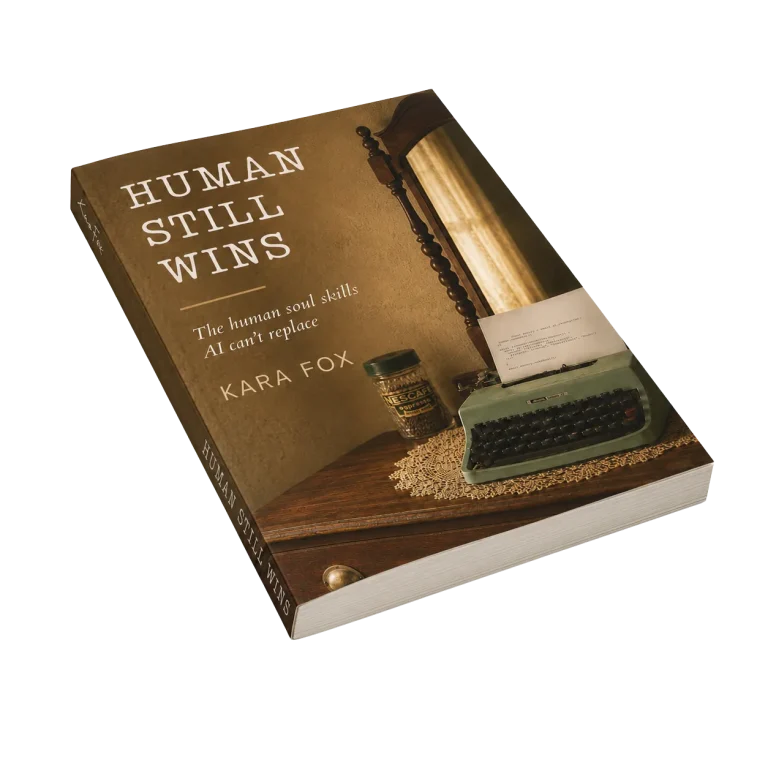
Human Still Wins
That was one chapter. The book is the whole argument.