The Internet’s Child
We applauded the internet without asking hard questions. We’re doing it again.
I was at dinner when a man took out his phone to read us something from his latest company newsletter, the way you do when an argument needs winning and you’ve decided the phone is the friend who’ll back you up. It was a (definitely an AI-generated) paragraph about enterprise software innovation; slick and smooth, but the kind of thing you’d scroll past without your eyes even registering the words. When he finished there was a reverent silence, followed by the exact sort of murmuring you get at wine tastings when someone identifies a note of blackcurrant leaf you hadn’t noticed yourself and now you cannot taste anything else, and everyone nods like they agreed from the first sip. It’s a thing we humans do, a particular way we perform appreciation in groups; the way one person’s delight gives the rest of us permission for the room to tilt toward wonder before we’ve decided if it feels right to us as individuals.
The arrival of the internet did this too. I was there, late nineties, sitting in someone’s living room while Chumbawamba’s Tubthumping wailed out of the boombox with the front-loading CD tray, watching a girl in another country type words that appeared on a screen in front of us in real time. Greeted with rapture, we could now communicate across continents with strangers and friends instantly, without the costs of international phone calls or the waiting of snail mail or telegram. And we wept. What a great democratising force, everyone said. A library containing all human knowledge plus all human pathology, side by side… and we never quite settled the question of which was which. We were doting, mostly. Marvelling at the extraordinary facility of The Internet. The confidence! What it could do! We applauded everything.
We are doing it again today.
Now we welcome the dawning of the child of the internet, trailing the same cloud of superlatives, and we are still standing in the living room, like doting grandparents, still applauding, still marvelling.
There I am listening to a man explain to me with genuine tenderness that the AI wrote his newsletter, and it came out “actually pretty good, hey?” I am nodding, I am smiling, I am accepting the glass of wine someone has placed in my hand because the wine is not the problem, the wine is perfect, but something feels off that I can’t quite name yet.
AI produces essays! AI writes poems! AI does it with absolute certainty, with the confidence of someone who has never once been wrong because failure doesn’t live in AI the way it lives in humans. You know, that small, correcting voice that says maybe, that knows what it doesn’t know. AI has no hedging. It sounds like it’s never been uncertain of anything in its whole existence. Indulgently, we find that enchanting, which says something about our human nature.
But when you raise a child on applause alone it doesn’t learn better.
They will never learn that confidence has a cost or that they need to know the difference between inventing and remembering. They are still toddlers capable of producing something that looks like work, but absolutely incapable of telling you they are making it up until you call them out on it.
That is not quite lying, because lying needs an intention it does not have. It is something stranger: complete confidence with no idea when it is wrong. In a toddler that is a phase you grow out of. In a system deployed across the institutions people trust with their lives, medicine, law, journalism, education, it is something else a little disturbing.
Doting produced that, and doting will not fix it.
I think about the man with the newsletter and his genuine pleasure, and I am not sure the applause is going to stop soon enough, which is maybe the thing that feels off and that has driven me to write this book.
I met with Sheona in Cape Town some months back. She makes documentaries and watches the world with that particular filmmaker’s eye, assessing everything like she’s already deciding where to cut. She uses AI to reshape her own film writing for grant applications and festival submissions; she would never use it to generate the documentary itself. And she reviews everything before it leaves her hands because she can tell, she said very calmly like it was obvious, the moment something has been AI-written.
What’s missing, she said, is the sense that a real person selected it and shaped it. She described consciousness, the human thread that machines simply are not part of. She was describing what it feels like to notice the presence or the absence of a human. She’s right; you can feel it. The difference between something made and something generated.
What is needed now is the same scrutiny we extend to anything else we invite into our institutions. We must ask what it cannot do as rigorously as we ask what it can.
Don’t start with wonder, but rather with wariness, and then find out what AI is actually for. Soul is the boundary between what is truly good and what is simply good enough.
When I say ‘soul’, I don’t mean doctrine. I mean the part of us that cares, chooses, and creates meaning.
I walked back to my car after that meeting where the light was doing that thing it does in autumn, going all golden and slanting across the buildings, and I thought about what we lose when we stop using our own minds. I thought of all the meetings I’ve sat in during my career where decisions carry weight, where someone’s job or future is contingent on a call being made carefully and with full attention. Too often I’ve watched a dashboard replace judgement and speed get mistaken for clarity, because the quarterly report is due Friday. We treat the machine’s output as an oracle when it is only a draft.
This time, we start with caution, and never, not for a second, let the machine’s confidence become a substitute for our own.
The internet raised itself, more or less, and we are still living with the consequences.
It would be nice to parent this one rather better.
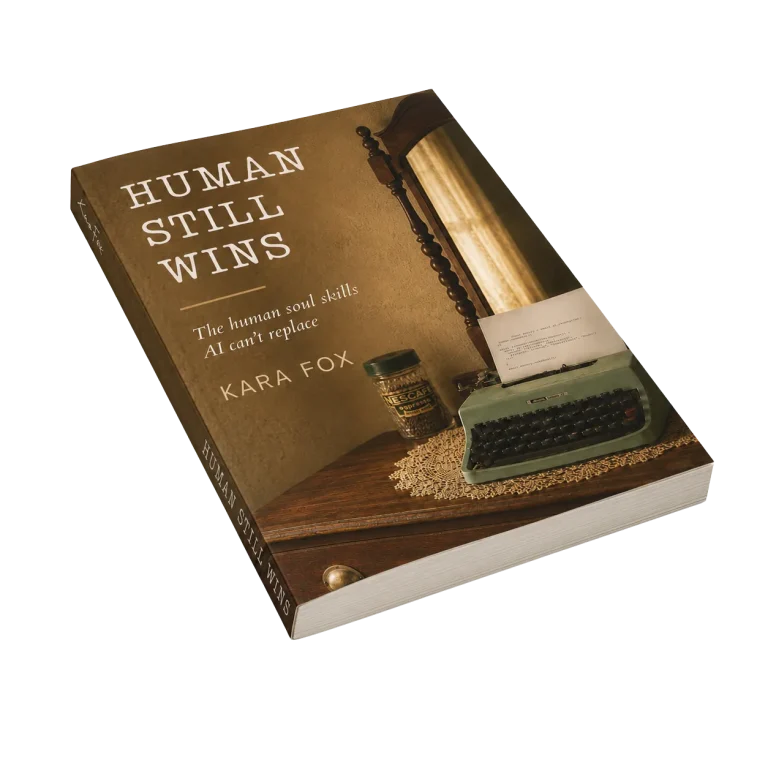
Human Still Wins
That was one chapter. The book is the whole argument.